Slip On Flanges from Texas Flange
Texas Flange is a premier supplier of slip on flanges, offering a comprehensive range of steel flanges in various materials, sizes, and specifications. We serve the oil and gas, petrochemical, power generation, and water treatment industries worldwide.
Our slip on flanges are manufactured to meet ANSI, ASME, API, and international standards. We carry sizes from 1/2" to 203" in pressure classes 150 through 2500.
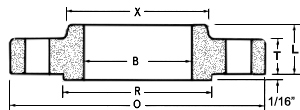
How a Slip-On Flange Sits on the Pipe
A slip-on flange takes the pipe into the bore. You fillet-weld the OD of the pipe to the hub and, on a standard hubbed slip-on, the inside as well. ASME B16.5 covers the sizes through NPS 24. This is the type, not a dimension table — slip-on dimensions sit on the same class pages as weld neck and blind.
The bore is larger than the pipe OD on purpose. The fitter slips the flange on, sets standoff, and welds. There is no weld bevel on the flange. Pipe length can still be trimmed after the flange is on, which is why shops reach for a slip-on flange on lower-class spools and utility lines.
Most have a hub. Ring-style (no hub) exists when space is tight and the application allows it. Higher-class slip-ons are sometimes built with lap-joint hub height so there is more steel behind the fillet. That is a geometry call on the RFQ, not a different ASME type.
A standard hubbed slip-on flange is welded around the pipe OD and on the interior side of the connection. Two fillet welds. A ring with no hub may be a single fillet if the print says so. Do not treat that as a weld-neck bevel.
Where the standard stops
ASME B16.5 covers slip-ons through NPS 24. Past 24, a slip-on is not a B16.47 part. B16.47 is weld neck and blind only. A large slip-on is custom or an industry pattern, and the engineer signs it.
RF is the common face. RTJ slip-ons exist: the groove is machined on the face. Spec the face. Do not assume RF. Flat face follows the same rule as any other type: match the mate, especially on cast iron.
Versus weld neck
A weld neck butt-welds through a tapered hub. A slip-on flange fillet-welds front and back. The weld neck carries higher pressure, temperature, and fatigue because the hub and the butt weld are the load path. The slip-on is faster to fit. On high class, vibration, or cyclic thermal service, the weld neck is the part.
Order line
NPS, class, slip-on, face, grade. Bore is pipe-OD clearance, not a weld-neck schedule bore. Custom OD, ID, thickness, and bolt pattern when it is off the table, including a single piece, out to 203 inches. If the slip on flange has to match an existing bolt pattern that is not in B16.5, send the pattern with the RFQ.
Slip-on type page · Class 150 table · Class 300 table · Class 600 table
Materials Available
We supply slip on flanges in a wide range of materials to meet the demands of any application:
Flange Types We Supply
In addition to slip on flanges, Texas Flange supplies a full range of flange types including:
Sizes & Pressure Classes
Texas Flange stocks and supplies slip on flanges from 1/2" through 203" (5100mm) in pressure classes 150, 300, 400, 600, 900, 1500, and 2500 as custom designed, not to B16.5 spec. We can accommodate custom sizes and specifications for special applications.
Standards & Specifications
All slip on flanges from Texas Flange are manufactured in accordance with major industry standards including ASME B16.5, ASME B16.47, API 605, MSS SP-44, and EN/DIN standards. We provide full material test reports (MTR) and can accommodate special testing and certification requirements.
About Slip On Flanges
Slip-on flanges are basic hub and ring flanges designed for quick installation with piping. The pipe and/or tubing slides right into the bore of the flange, and then it gets welded on both sides: around the outside of the pipe and on the interior of the connection.
One of the things people like about slip-ons is how forgiving they are during fit-up. Since there's no weld bevel, you can slide the pipe back and forth to dial in the exact position before you commit to welding. The bore is intentionally sized with a little extra room, giving the welder and fabricator enough space to work comfortably.
You'll most often see slip-on flanges in lower-pressure applications. The standard version comes with a hub (that raised portion around the bore) which looks a lot like a raised face in terms of its dimensions but is generally much taller. If space is tight or the application allows for it, you can also get a "ring style" slip-on with no hub at all. Both versions are legitimately slip-on flanges; it just comes down to what your situation calls for. In higher pressure classes, slip-ons are sometimes made with the same hub height as a lap joint flange for a better connection. And if a lap joint isn't readily available, some customers will order a slip-on machined to lap joint dimensions as a practical workaround.
That said, slip-ons do have their limits. As pressure and mechanical stress increase, a weld neck flange becomes the better choice. The reason comes down to the weld itself: a slip-on uses a fillet weld, while a weld neck has a tapered hub that transitions smoothly into a full butt weld connection with the pipe. That taper is what gives the weld neck its edge in demanding service conditions.
For more information about flanges, visit Wikipedia's article on flanges.
From Our Blog
The Role of Slip On Flanges in Industrial Piping Systems
Slip on flanges are a vital component in industrial piping systems, known for their versatility and ease of use.
June 21, 2024The Advantages of Using Slip On Flanges in Piping Systems
Slip on flanges are a popular choice in many piping systems due to their ease of use, versatility, and cost-effectiveness.
June 21, 2024Ready to Order Slip On Flanges?
Contact Texas Flange today for pricing, availability, and expert technical support on all your flange requirements.